
Copyright © 2022 Adewo Automation Equipment Co.,ltd. All rights Reserved.
Links Sitemap RSS XML Privacy Policy

From Skilled Hands to Smart Manufacturing: Why Die Makers Are Rethinking Blade Bending Technology?
For decades, die making has been considered a highly skill-dependent industry. The ability to understand steel rule behavior, control bending angles, and adjust blade shapes through experience was often the difference between an ordinary operator and an experienced technician.
However, the role of experience is changing.
As packaging designs become more complex and customers demand shorter delivery times, die makers are facing new challenges. Modern cutting dies require more complicated shapes, tighter accuracy control, and consistent production quality. In this environment, relying only on manual adjustment is becoming increasingly difficult.
The question for many manufacturers is no longer “Can we bend the blade?” but rather “Can we produce the same quality repeatedly with higher efficiency?”
This shift is driving the development of intelligent automatic blade bending technology.
When Experience Becomes Difficult to Transfer
Traditional die manufacturing relies heavily on skilled workers. Experienced technicians know how to adjust bending pressure, control blade positioning, and solve unexpected problems during production.
But this manufacturing model also creates several challenges.
First, skilled operators require years of training. New employees often need a long learning period before they can independently handle complex die structures.
Second, manual operation can lead to differences between operators. Even with the same design file, different working habits may result in slightly different bending results.
For die manufacturers producing packaging dies, printing dies, and precision cutting tools, these small differences can influence the final cutting performance.
As production requirements continue to improve, manufacturers are looking for a way to transform personal experience into a repeatable manufacturing process.
Digital Files Are Becoming the New Manufacturing Language
One of the biggest changes in modern die production is the connection between design software and manufacturing equipment.Instead of manually measuring every bending position, advanced automatic bending machines can process digital design data and convert it into machine movements.
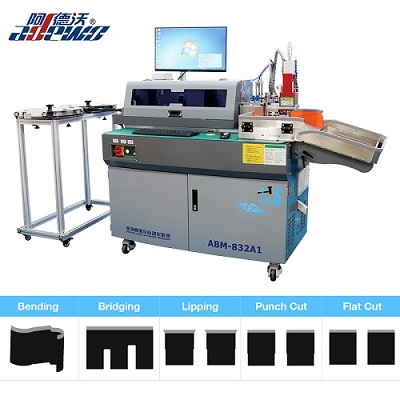
The ABM-832A1 Auto Bender Machine is designed around this manufacturing concept. By supporting DXF and DWG file formats, the machine allows digital drawings to directly guide the bending process, reducing unnecessary manual adjustments.
Multi-Function Processing: Simplifying Complex Die Manufacturing with One Integrated Machine
As die designs become more complex, traditional workflows often require separate machines and repeated operations, increasing processing time and management difficulties.
By combining multiple operations in a single workflow, it helps reduce unnecessary transfers, simplify production processes, and improve overall manufacturing efficiency.The ABM-832A1 integrates functions including :
Bending
Mold cut
Bridging
Lipping
Flat cut
Optional functions perforation or hole
Integrated Bending & Cutting: Saving Factory Space and Reducing Equipment Investment
With increasing pressure on production costs and factory space, manufacturers are paying more attention to compact and efficient equipment solutions.
The ABM-832A1 combines bending and cutting functions in one system, eliminating the need for separate machines. This integrated design saves valuable workspace, reduces equipment investment, and provides a more practical solution for die makers looking to improve production capacity.

High Precision & Repeatability: Ensuring Stable Quality in Continuous Production
For modern die manufacturers, achieving accuracy once is not enough. Maintaining consistent results across repeated production is the real challenge.
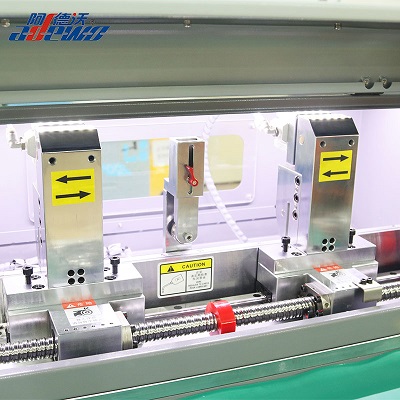
With precise control technology and double clamps,screw guide feeding continously, the ABM-832A1 delivers reliable bending results during continuous operation. This helps reduce manual corrections, improve repeatability, and maintain consistent die quality for different production batches.
Automated Workflow: Reducing Manual Adjustment and Improving Production Efficiency
As skilled technicians become harder to recruit, manufacturers are looking for ways to reduce dependence on manual experience while maintaining stable quality.
The ABM-832A1 simplifies operation through automation and intelligent control, helping transform traditional experience-based production into a more standardized workflow. By reducing adjustment time and improving processing efficiency, it enables manufacturers to respond faster to changing market demands.
Copyright © 2022 Adewo Automation Equipment Co.,ltd. All rights Reserved.
Links Sitemap RSS XML Privacy Policy