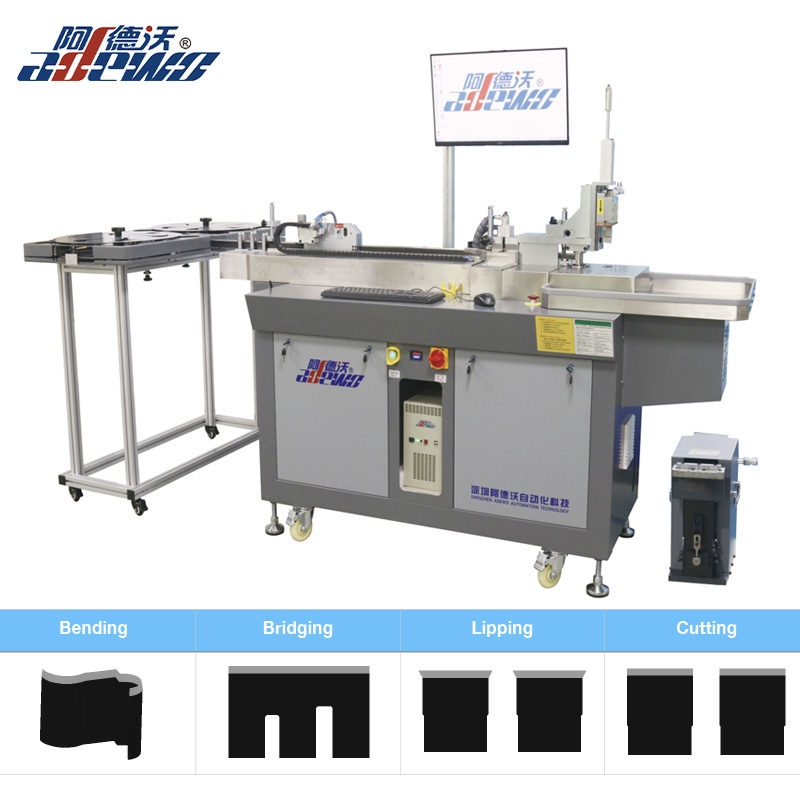

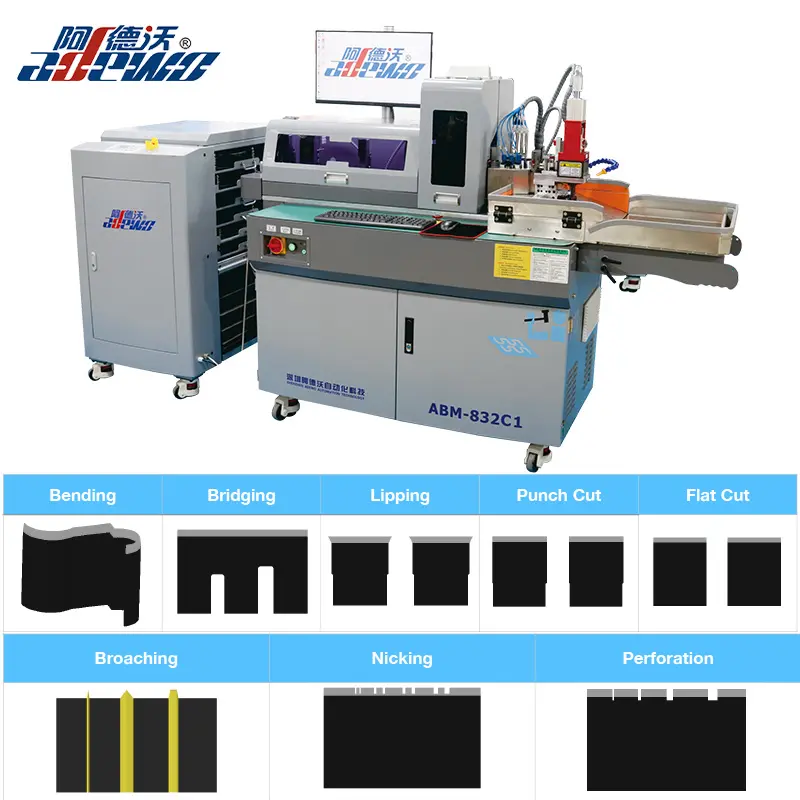


In the die-making industry, the steel rule is the cutting edge of the die. Its accuracy determines the quality of every box, carton, or packaging product that is cut. A steel rule that is bent inaccurately by even a fraction of a millimeter will produce a die that fails to cut cleanly, leading to costly production waste. For decades, the bending of steel rule was a manual process, requiring skilled operators to use hand tools and physical templates. The results were only as good as the operator's skill, and consistency was difficult to achieve. The introduction of the auto bender transformed this process, bringing the precision of computer numerical control to the bending of steel rule.
The core of the auto bender's accuracy lies in its bending function. This function is not a simple mechanical action; it is a sophisticated interplay of servo motors, precision tooling, and real-time control algorithms. The Basic Model Auto Bender, engineered by Adewo Automation Equipment Co.,ltd., is designed to deliver consistent, high-accuracy bends that meet the exacting demands of modern die-making. This article provides a technical analysis of the bending function, explaining the mechanisms that enable accurate shaping of steel rule. We will examine the servo control system, the geometry of the bending tooling, the compensation algorithms that account for material springback, and the quality control measures that ensure every bend is precise.
The bending function in an auto bender is the mechanical and electronic system that transforms a straight length of steel rule into a precisely shaped cutting edge. A steel rule is a strip of hardened steel with a sharp cutting edge on one side and a serrated or plain body on the other. It is used in die-making to create the cutting path of a die. The auto bender takes a straight rule, feeds it into the bending head, and then executes a series of bends to create the desired shape. The bending function must be capable of producing bends of various angles (typically 90 degrees, but also other angles) and radii, with a high degree of accuracy and repeatability.
The bending function is composed of several key components. The first is the feed mechanism, which advances the steel rule to the correct position for each bend. The feed mechanism uses precision rollers or a gripper system to move the rule with accuracy. The second component is the bending head, which contains the tooling that actually forms the bend. The bending head typically uses a combination of a bending punch and a die, or a set of rollers, to deform the steel rule. The third component is the control system, which coordinates the feed and bending actions based on the programmed pattern. The control system uses servo motors to drive the feed and bending axes, ensuring that the movements are precise and repeatable.
The accuracy of the bending function is determined by the precision of these components and the control algorithms that manage them. At Adewo Automation Equipment Co.,ltd., our Basic Model Auto Bender is designed to achieve a bending accuracy of +/- 0.1 mm for the bend position and +/- 0.5 degrees for the bend angle. This level of accuracy is essential for producing dies that meet the tight tolerances required for high-quality packaging. The following table provides a summary of the key components of the bending function and their roles.
| Component | Function | Impact on Accuracy |
| Feed Mechanism | Advances steel rule to bend position | Determines the accuracy of the bend location along the rule |
| Bending Head | Forms the bend in the steel rule | Determines the accuracy of the bend angle and radius |
| Servo Motors | Drive the feed and bending axes | Provide the precision and repeatability of the motion |
| Control System | Coordinates feed and bending actions | Ensures the correct sequence and parameters are used |
| Tooling | Punches or rollers that form the bend | Determines the quality of the bend and the tool life |
Servo control is the foundation of the bending function's accuracy. A servo motor is a motor that is equipped with a feedback device, typically an encoder, that reports the motor's position and speed to the controller. The controller compares the actual position with the commanded position and adjusts the motor's input to minimize the error. This closed-loop control is essential for achieving precise and repeatable motion. In an auto bender, the feed axis and the bending axis are both driven by servo motors. The feed axis must move the steel rule to the exact position for each bend. The bending axis must rotate the bending tool to the exact angle. Any error in these axes will result in an inaccurate bend.
The precision of a servo system is determined by several factors, including the resolution of the encoder, the stiffness of the mechanical system, and the quality of the control algorithm. A high-resolution encoder can detect very small changes in position, allowing the controller to make fine adjustments. A stiff mechanical system ensures that the motor's motion is transmitted to the tooling without backlash or flex. A well-tuned control algorithm ensures that the motor responds quickly and smoothly to commands, without overshoot or oscillation. At Adewo Automation Equipment Co.,ltd., our Basic Model Auto Bender uses high-resolution absolute encoders and a rigid mechanical structure to ensure precise servo control. Our control algorithms are tuned to provide fast, stable response for the demanding requirements of steel rule bending.
The following table compares the performance of a servo-controlled bending function with a stepper motor-controlled bending function. Stepper motors are another common option for motion control, but they have limitations in accuracy and torque.
| Parameter | Servo Control | Stepper Motor Control |
| Feedback | Closed-loop (encoder) | Open-loop (no feedback) |
| Position Accuracy | High (+/- 0.01 mm typical) | Moderate (+/- 0.05 mm typical) |
| Repeatability | Excellent | Good |
| Torque at High Speed | High | Decreases with speed |
| Risk of Lost Steps | None (closed-loop) | Possible under overload |
| Cost | Higher | Lower |
The use of servo control in our Basic Model Auto Bender is a key reason for its superior bending accuracy. The closed-loop feedback ensures that the machine always knows the exact position of the feed and bending axes, and it can correct any errors in real time. This is particularly important when bending high-strength steel rules, which require higher forces and can cause a stepper motor to lose steps. With servo control, the machine maintains its accuracy even under demanding conditions.
The geometry of the bending tooling is another critical factor in achieving accurate bends. The tooling consists of the bending punch and the bending die, or in some designs, a set of forming rollers. The shape and dimensions of the tooling determine the radius and angle of the bend. The tooling must be designed to match the properties of the steel rule, including its thickness, hardness, and the desired bend radius. A mismatch between the tooling and the rule can result in inaccurate bends, cracking, or excessive tool wear.
The key tooling parameters that affect bend precision are the punch radius, the die opening, and the die angle. The punch radius determines the inside radius of the bend. The die opening determines the amount of material that is bent and the springback characteristics. The die angle determines the final angle of the bend. For a standard 90-degree bend, the die angle is typically 90 degrees, but the punch and die must be designed to account for the springback of the steel rule. Springback is the tendency of the material to partially return to its original shape after the bending force is removed. To achieve a 90-degree bend, the tooling must over-bend the rule to, for example, 92 degrees, so that it springs back to 90 degrees.
The tooling in our Basic Model Auto Bender is manufactured from high-quality tool steel and is precision-ground to ensure accurate dimensions. The tooling is also designed for quick changeover, allowing the operator to switch between different bend radii and angles with minimal downtime. Our factory at Adewo Automation Equipment Co.,ltd. provides a range of tooling options to suit different steel rule types and bending requirements. The following table summarizes the key tooling parameters and their impact on bend precision.
| Tooling Parameter | Function | Impact on Bend Precision |
| Punch Radius | Determines the inside radius of the bend | Directly affects the bend radius accuracy |
| Die Opening | Determines the amount of material bent | Affects springback and the final angle |
| Die Angle | Determines the final angle of the bend | Must compensate for springback |
| Tool Material | Determines tool life and wear resistance | Affects long-term precision |
In addition to the tooling design, the alignment of the tooling is critical. If the punch and die are not perfectly aligned, the bend will be skewed, and the rule may twist. Our Basic Model Auto Bender uses precision guides and a rigid frame to ensure that the tooling remains aligned during operation. This alignment is checked and maintained as part of our routine maintenance procedures.
Springback is the enemy of accurate bending. When a steel rule is bent, the material undergoes both plastic and elastic deformation. The plastic deformation is permanent, but the elastic deformation is recovered when the bending force is removed. This recovery causes the rule to spring back, resulting in a bend angle that is less than the angle to which it was bent. The amount of springback depends on the material properties of the rule, its thickness, and the bend radius. If springback is not compensated for, the final bend angle will be inaccurate.
To achieve accurate bends, the auto bender must over-bend the rule to compensate for springback. The amount of over-bend is determined by a springback compensation algorithm. This algorithm is based on the material properties of the rule and the bend geometry. The algorithm calculates the required over-bend angle and commands the bending axis to move to that angle. When the bending force is released, the rule springs back to the desired angle. The accuracy of the compensation algorithm is critical to the overall accuracy of the bending function.
At Adewo Automation Equipment Co.,ltd., our Basic Model Auto Bender uses a sophisticated springback compensation algorithm that is based on extensive testing of different steel rule types. The algorithm takes into account the rule's thickness, hardness, and the desired bend radius. The operator simply enters the desired bend angle and radius, and the machine automatically calculates the required over-bend. The following table provides an example of springback compensation for different steel rule thicknesses.
| Rule Thickness (mm) | Desired Bend Angle | Over-Bend Angle (Typical) | Springback Compensation |
| 0.71 mm | 90° | 92.5° | 2.5° |
| 1.05 mm | 90° | 93.5° | 3.5° |
| 1.42 mm | 90° | 95.0° | 5.0° |
| 2.00 mm | 90° | 97.0° | 7.0° |
The springback compensation algorithm is a key feature of our Basic Model Auto Bender. It allows the machine to produce accurate bends without the need for manual trial-and-error adjustments. This not only improves accuracy but also increases productivity by reducing setup time and material waste.
Achieving accurate bends is one thing; maintaining that accuracy over time is another. The bending function of an auto bender is subject to wear, thermal drift, and other factors that can degrade its performance. To ensure that the machine continues to produce accurate bends, it is essential to have a program of verification and maintenance. This program should include regular calibration, inspection of the tooling, and verification of the machine's accuracy using test cuts.
The verification process typically involves bending a test rule to a known pattern and then measuring the resulting shape. The measurements are compared with the programmed dimensions. If the deviations exceed the acceptable tolerance, the machine is adjusted or recalibrated. The test pattern should include a variety of bend angles and radii to ensure that the machine is accurate across its full range. The test should be performed at regular intervals, such as at the start of each shift or after a tooling change.
At Adewo Automation Equipment Co.,ltd., we recommend the following verification and maintenance schedule for our Basic Model Auto Bender:
The following table provides a summary of the verification and maintenance tasks for the bending function.
| Task | Frequency | Purpose |
| Visual Inspection of Tooling | Daily | Detect wear or damage |
| Test Bend Pattern | Weekly | Verify machine accuracy |
| Lubrication of Moving Parts | Weekly | Reduce wear and ensure smooth motion |
| Inspection of Servo Motors | Monthly | Ensure proper operation and detect wear |
| Full Calibration | Annually | Restore machine to factory specifications |
By following a structured verification and maintenance program, users of our Basic Model Auto Bender can ensure that their machine continues to produce accurate bends for many years. Our factory provides comprehensive training and support to help our customers implement these procedures.
Question 1: What is the typical bending accuracy of a Basic Model Auto Bender?
Answer: The typical bending accuracy of our Basic Model Auto Bender is +/- 0.1 mm for bend position and +/- 0.5 degrees for bend angle. This level of accuracy is suitable for the majority of steel rule die-making applications. For applications requiring even higher accuracy, we offer advanced models with higher-resolution encoders and more sophisticated compensation algorithms.
Question 2: Can the auto bender bend steel rule with different thicknesses?
Answer: Yes, the Basic Model Auto Bender can bend steel rule with different thicknesses. The machine's control system includes a database of bending parameters for different rule types and thicknesses. The operator simply selects the rule type and thickness, and the machine automatically adjusts the bending parameters, including the springback compensation. This makes the machine highly versatile and easy to use.
Question 3: How does the auto bender handle different bend radii?
Answer: The auto bender can handle different bend radii by using different tooling sets. The punch and die are changed to match the desired bend radius. The machine's control system is programmed with the tooling geometry, so it automatically adjusts the bending parameters to achieve the correct radius. Tooling changes are typically quick and easy, allowing the operator to switch between different radii with minimal downtime.
Question 4: What is the maximum bending angle that the auto bender can achieve?
Answer: The maximum bending angle depends on the tooling and the machine's design. For a standard setup, the machine can achieve bends up to 90 degrees. For special applications, custom tooling can be provided to achieve other angles, including acute and obtuse bends. Our factory at Adewo Automation Equipment Co.,ltd. can provide custom tooling to meet specific requirements.
Question 5: How does the auto bender ensure that the bends are in the correct position along the rule?
Answer: The auto bender uses a precision feed mechanism to advance the steel rule to the correct position for each bend. The feed mechanism is driven by a servo motor and controlled by the machine's CNC system. The feed position is programmed for each bend, and the closed-loop servo control ensures that the rule is positioned accurately. The machine also uses a sensing system to detect the leading edge of the rule and to verify the feed position.
The bending function of an auto bender is a sophisticated system that combines precision mechanics, advanced servo control, and intelligent software to shape steel rule accurately. The accuracy of the bending function is determined by the precision of the feed and bending axes, the geometry of the tooling, the effectiveness of the springback compensation algorithm, and the rigor of the verification and maintenance program. The Basic Model Auto Bender from Adewo Automation Equipment Co.,ltd. is designed to deliver the highest levels of accuracy and repeatability, enabling die-makers to produce high-quality dies with confidence.
If you are looking to improve the accuracy and efficiency of your steel rule die-making operations, we invite you to learn more about our Basic Model Auto Bender. Our team of experts is available to discuss your specific requirements and to demonstrate how our machine can meet your needs.
Contact Adewo Automation Equipment Co.,ltd. today to learn more about our Basic Model Auto Bender and how it can improve your die-making accuracy.