
Copyright © 2022 Adewo Automation Equipment Co.,ltd. All rights Reserved.
Links Sitemap RSS XML Privacy Policy

1. Beyond Paper Thickness: Understanding the Structure of Corrugated Board
Light weighting has become an important direction in the corrugated packaging industry. Packaging manufacturers are continuously exploring ways to reduce material consumption while maintaining sufficient strength, cushioning and stacking performance.
However, the performance of a corrugated box is not determined by paper grammage alone.
Its construction, flute profile, paper properties and converting quality all contribute to the final result.
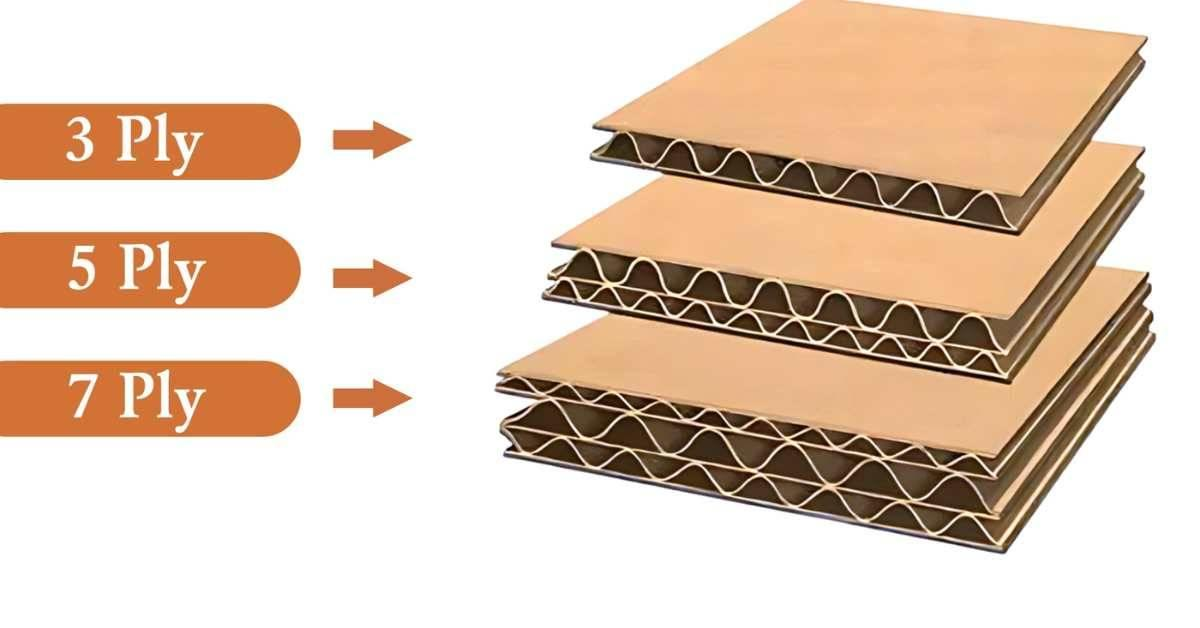
Corrugated board generally consists of flat liner boards bonded to a fluted medium. The fluted layer provides cushioning and contributes to the structural performance of the board.
Depending on the intended application, manufacturers select different flute profiles and board constructions.
2. Different Flutes, Different Packaging Requirements
Common flute profiles include A, B, C, E and F, as well as combinations such as BC and EB.
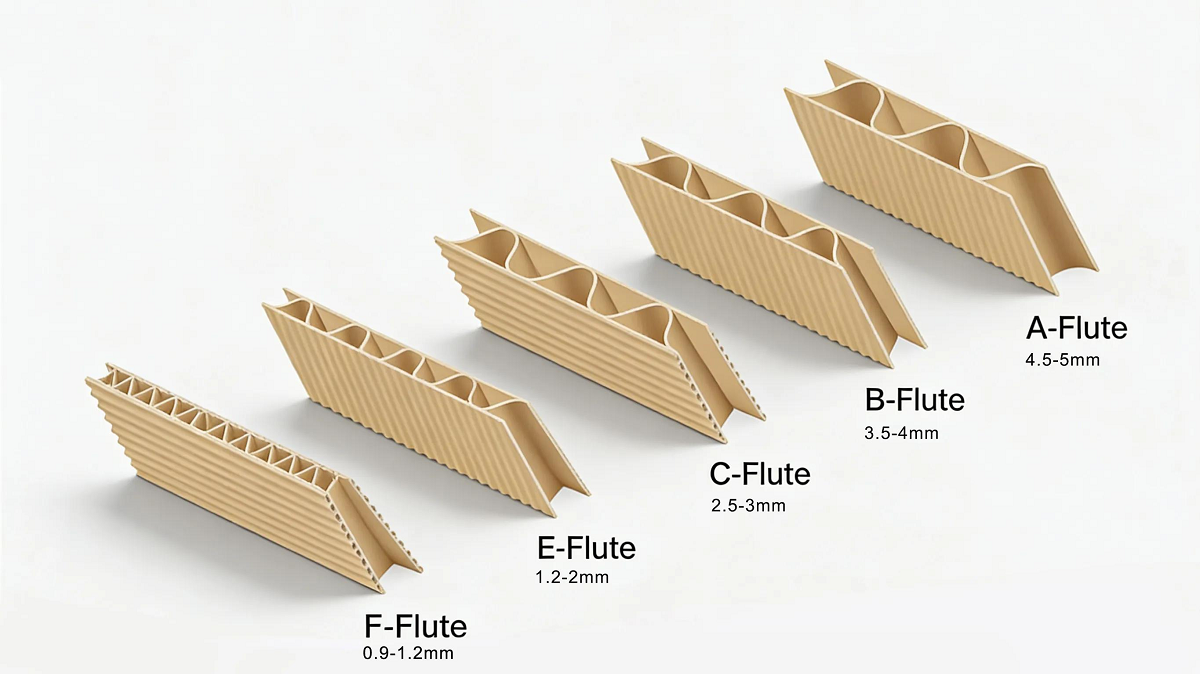
A Flute
Relatively high flute profile, commonly selected where cushioning is important.
B Flute
A finer structure with good crush resistance, often used for shipping and retail packaging.
C Flute
Offers a balance between cushioning and stacking performance.
E Flute
A thinner profile suitable for compact packaging and improved printing surfaces.
F Flute
An even finer profile used in certain lightweight and premium packaging applications.
BC/EB Flute
Double-wall constructions combining different flute profiles to meet more demanding packaging requirements.
The selection of flute type depends on product weight, transportation conditions, stacking requirements, printing needs and overall packaging design.
A thinner board does not automatically mean a weaker box, just as a thicker board does not automatically guarantee better performance.
The entire packaging structure needs to be considered.
3. Where Does Die-Cutting Enter the Corrugated Packaging Process?
Corrugated board manufacturing and die cutting are two different stages.
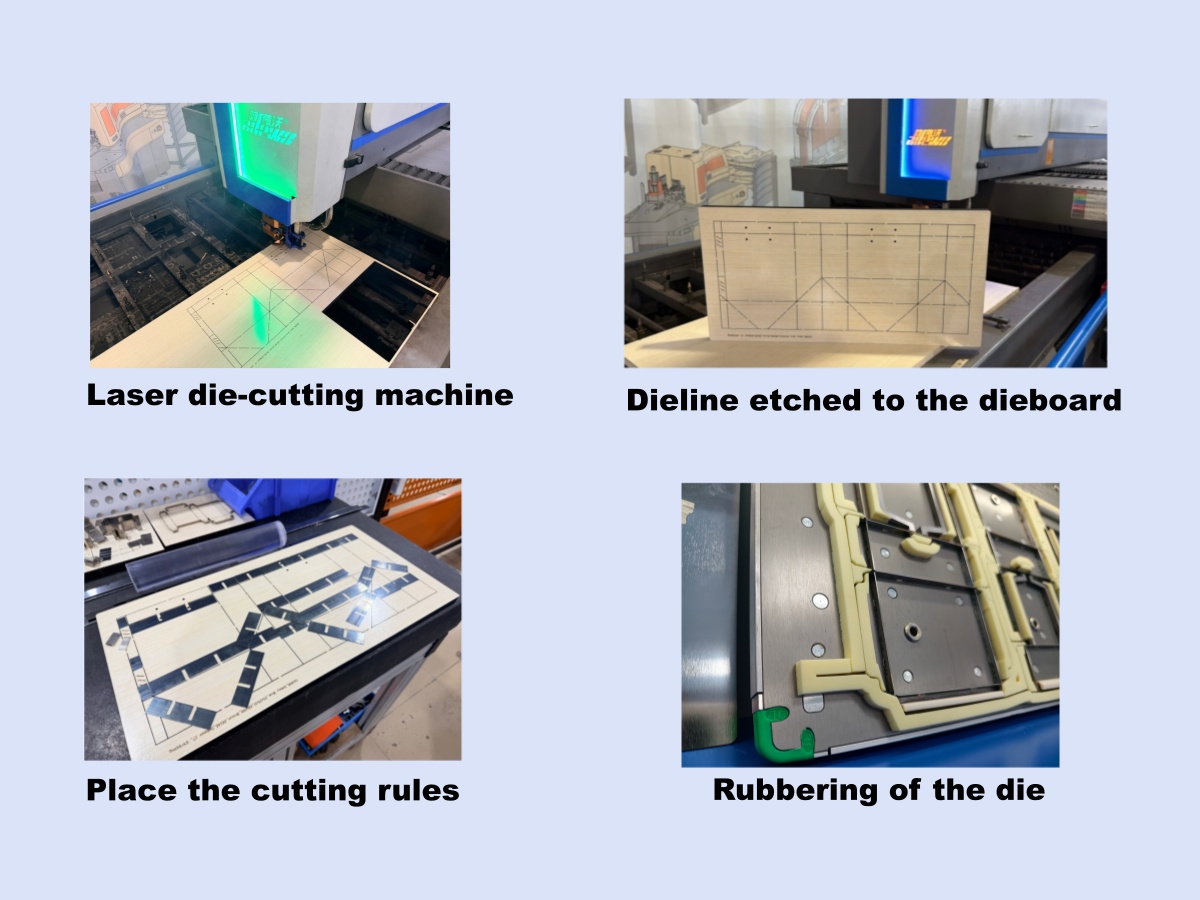
During corrugation, heated rollers form the fluted medium, which is then bonded to liner board.
After the board is manufactured and printed, it enters the converting stage. Depending on the production line, operations may include cutting, creasing, slotting, die cutting, folding and gluing.
This is where cutting dies become important.
A steel-rule die contains cutting rules and creasing rules installed in a die board according to the packaging design.
The cutting rules define the external shape and openings, while creasing rules create controlled folding positions.
Slotting and other special cutting structures help form box flaps, locking mechanisms and customized packaging features.
The die therefore acts as the connection between packaging design and actual box production.
4. Why Creasing and Cutting Quality Matter
Corrugated board has a layered structure, so its response to cutting and creasing differs from that of ordinary paperboard.
An unsuitable creasing configuration or excessive die-cutting pressure may damage the liner or crush the fluted medium around the folding line.
This can affect folding accuracy, appearance and the structural performance of the finished box.
Several factors need to be considered:
For example, an E-flute retail carton and a BC-flute industrial shipping box should not automatically use the same creasing configuration.
The correct solution needs to be established according to the actual board specification and verified through die-cutting and folding tests.
5. Die-Making Precision
An Often-Overlooked Part of Packaging QualityEven a well-designed packaging structure can encounter production problems if the cutting die is not manufactured accurately.
Incorrect slot positioning, unstable steel-rule installation, inconsistent bending angles or poorly matched creasing structures may result in dimensional deviations and irregular folding.
For packaging manufacturers handling customized boxes, partitions, display packaging and protective inserts, die quality becomes particularly important.
The relationship is straightforward:
The corrugator establishes the board structure.
The cutting die defines the cutting and folding geometry.
The converting line transforms the board into the finished package.
Each stage contributes to the final result.
6. A More Integrated Approach to Corrugated Packaging
As corrugated packaging continues to develop towards lightweight construction and customized designs, manufacturers need to consider more than raw materials and corrugation equipment.
Cutting and creasing quality should also be included in packaging process evaluation.
Understanding the relationship between flute profiles, die structures and converting conditions helps manufacturers make more informed decisions when developing new packaging designs.
Better corrugated packaging is not created by one process alone. It comes from the coordination of material, structure, tooling and manufacturing precision.
Copyright © 2022 Adewo Automation Equipment Co.,ltd. All rights Reserved.
Links Sitemap RSS XML Privacy Policy