

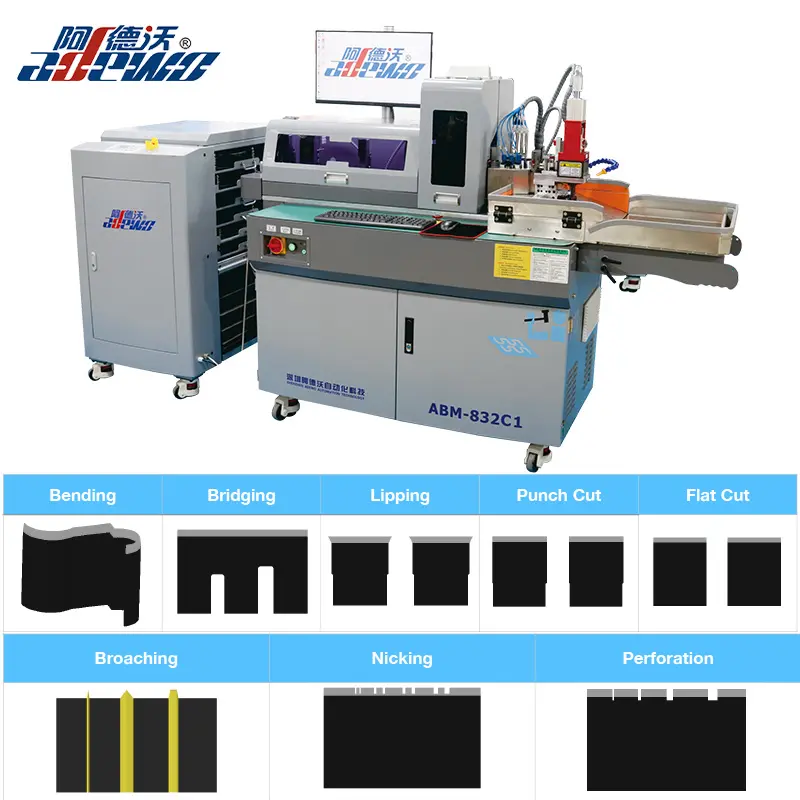


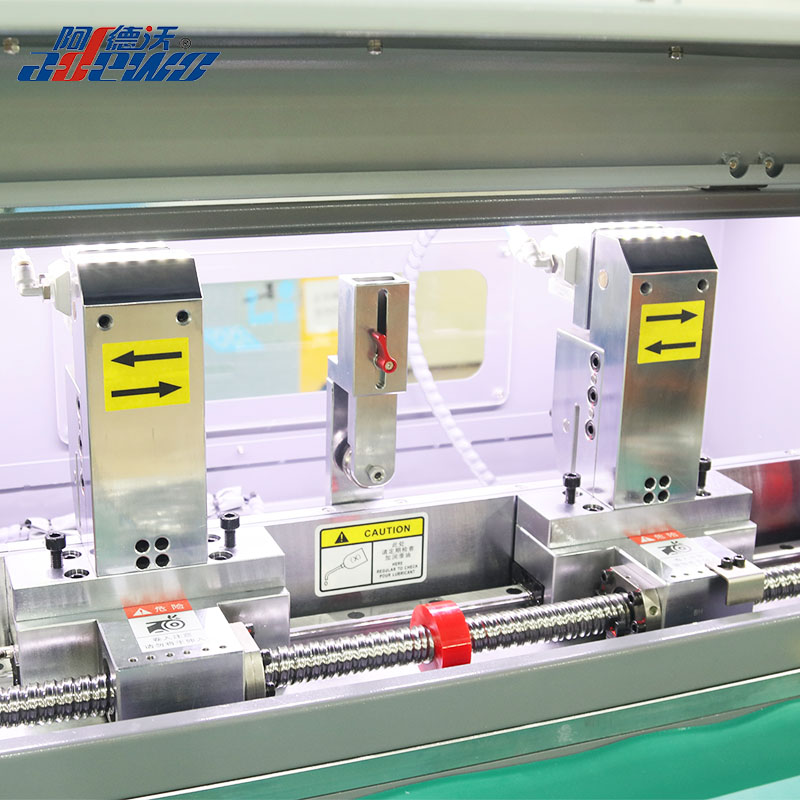
Dual-clamp screw feeding ensures machining precision and repeatability
The ABM-832C2 utilizes a dual-clamp and screw guided continuous feeding structure. High-precision positioning enhances stability and repeatability during the blade bending process.
This feeding method minimizes positional deviation, improves consistency in cutting die production, and balances processing efficiency with positioning accuracy during continuous manufacturing.
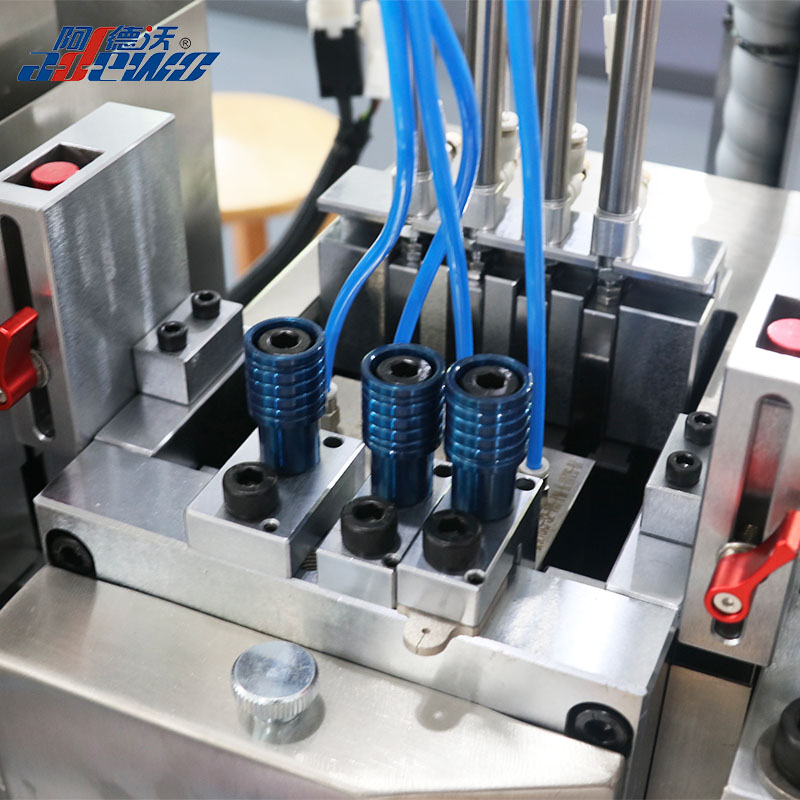
Integrated multifunctional punching tools for complex die production
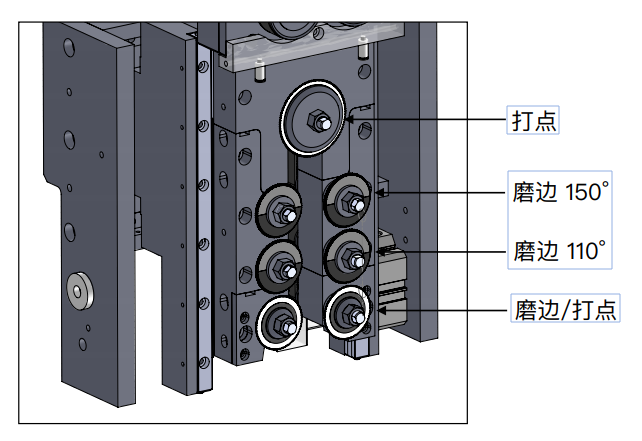
The ABM-832C2 supports a multifunctional punching tools configuration, accommodating up to six types of tools—including those for bridges, lipping, mold cut, perforation, and hole. Tools can be combined based on specific customer requirements to meet the technical specifications of various die types.
The equipment supports the simultaneous installation of tools with different edge angles. When processing blades with varying angles, software parameter adjustments allow for seamless adaptation without the need to change tools, thereby increasing flexibility during production transitions.
Multiple broaching and nicking configurations enhance precision machining capabilities.
The equipment offers various combinations for broaching and nicking, including wide/narrow broaching configurations and diverse nicking saw blades specifications. It can be configured with up to two broaching sets and three nicking sets (or one nicking set combined with three broaching sets), making it ideal for high-precision die manufacturing.
Additionally, if standard nicking setups prove insufficient, an independent nicking unit can be added. The system supports the simultaneous assembly of three nicking saw blades to create connected nicking points; this significantly boosts production efficiency and offers a longer service life compared to using a single blade for multiple nicking points.
The equipment also supports bottom nicking, which improves die flatness, ensuring uniform pressure distribution, clean cuts, and precise creasing results.
Integrated bending and cutting functions shorten production cycles
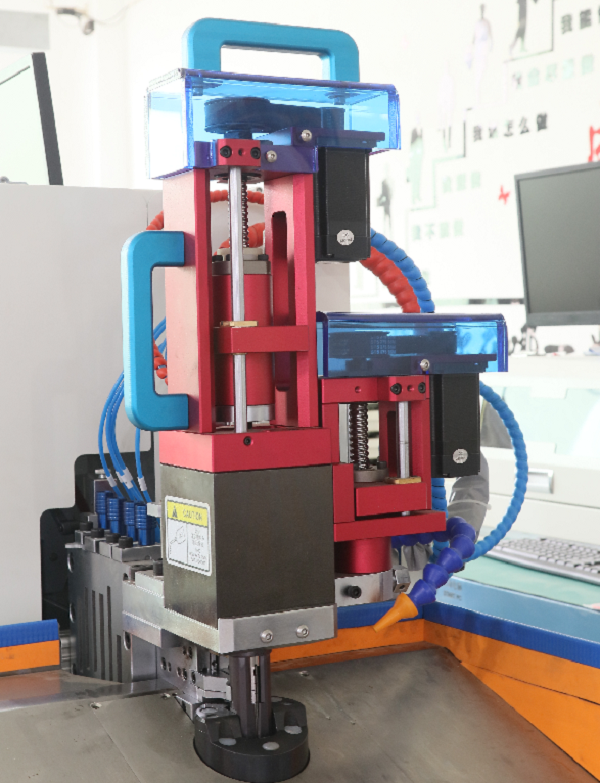
By integrating bending and cutting capabilities, the equipment reduces the need for manual intervention and process transitions. This integrated approach minimizes human interference, enhances cutting safety, and improves both production cycle times and processing consistency.
For die production scenarios requiring multiple sequential processing steps, this design optimizes the workflow and reduces repetitive operations. Configuration Options for High-Precision Cutting Die Manufacturing
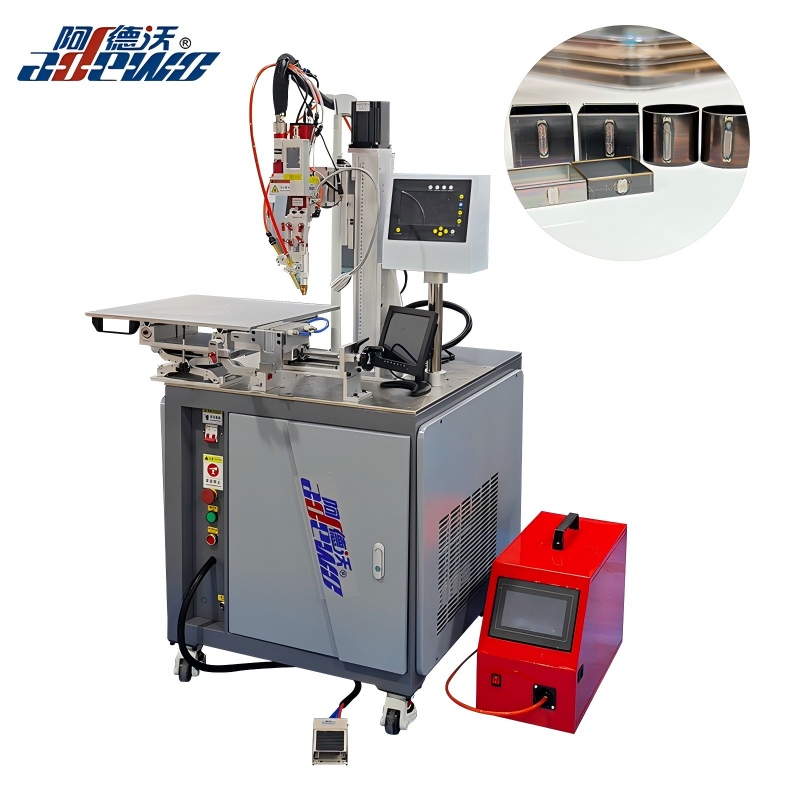
For applications requiring superior die flatness, the equipment can be upgraded to the PRO model, offering a choice between single-motor and dual-motor drive systems.
Additionally, configurable options are available to accommodate varying blade material thicknesses, thereby reducing the operational burden of frequently changing bending shaft&sleeve and enhancing overall ease of use.
Conclusion
Centered on precision feeding, integrated multi-functional punching tools, and combined bending and cutting capabilities, the ABM-832C2 meets the diverse processing needs of high-precision cutting dies through flexible broaching and nicking configurations.
From die configuration to the production workflow, the equipment prioritizes process adaptability, machining consistency, and operational efficiency, providing technical support for the automated upgrading of high-precision cutting die manufacturing.
FAQ:
Q:Can the depth and width of the nick be adjusted?
A:The nicking depth can be adjusted by software,and the width can be done by replacing nicking saw blades or changing the number of repeated processing times with the same saw blade.
Q:Is the independent tool easier to replace?
A:Yes, absolutely. Our independent tool design makes changeovers remarkably simple — you only need to unscrew one single bolt and disconnect the air hose to remove the old tool; installing a new tool is equally quick. The entire process takes about one minute and requires no specialized maintenance technician — regular operators can handle it with minimal guidance, effectively reducing downtime and boosting production efficiency.
Q:What maintenance does the machine need in daily life?
A: 1.Clean the sensors by wiping with cotton swabs frequently
2.Maintenance of Motion Axle
3.Grinding Machine: Use a brush to clean the edge grinding powder frequently to avoid the powder from getting on the screw and feeding track.Grinding up&down screw, Grinding depth screw, Nicking height screw, Bottom Nick screw, and dust boxes, cleaning waste ports, etc., to keep the machine clean and working
Related News:
832C2 Automatic Bending Machine: Suitable for Sandwich Die Making and High-End Packaging Die Making?
High Accurate Steel Rule Auto Bender Machine?