
Copyright © 2022 Adewo Automation Equipment Co.,ltd. All rights Reserved.
Links Sitemap RSS XML Privacy Policy

What exactly enables die-cutting processing to achieve such precise forming?
Why must every die-cut product rely on a cutting die?
Though it may appear to be a simple cutting process, the die-makingis in fact the very soul of die-cutting.
1. A cutting-die is essentially the forming template for a product.
In die‑cutting processes, product contours, hole diameters, crease lines, and cut‑out patterns are all reproduced by the die's cutting edge geometry; the press merely supplies vertical force, while the final dimensional tolerances and edge quality depend on the die's fabrication accuracy.
2.The cutting-die directly determines the dimensional accuracy and yield rate of the finished product.
Many batch-to-batch deviations,burrs,and chipping issues can be traced back to the cutting-die itself.
Edge sharpness,hardness , and contour deviation —directly impact batch dimensional consistency, burr occurrence, and chipping risk.
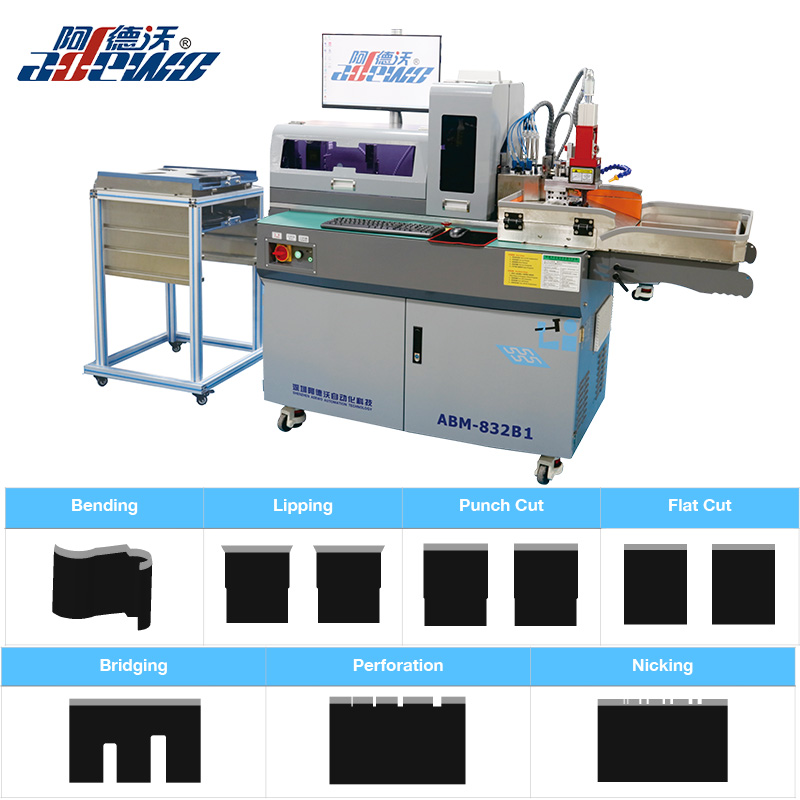
Our curved‑blade bender series (A1, B1, A2580) ensure die quality through the following technical features:
· Feeding precision: Dual‑clamp‑screw feeding mechanism with repeated positioning accuracy of ±0.03 mm, ensuring consistent bend point coordinates;
· Punching unit: Modular die design with adjustable clearance (compatible with rule thickness 0.45–1.05 mm).
· Bending forming: Servo‑controlled bending angle with bending flatness 0.2mm, paired with quick‑change inner shaft to accommodate varying blade thicknesses and diameter.
· Specialized functions:
B1 integrates a nicking station with adjustable depth (minimum 0.2 mm) for pre-creasing in packaging;
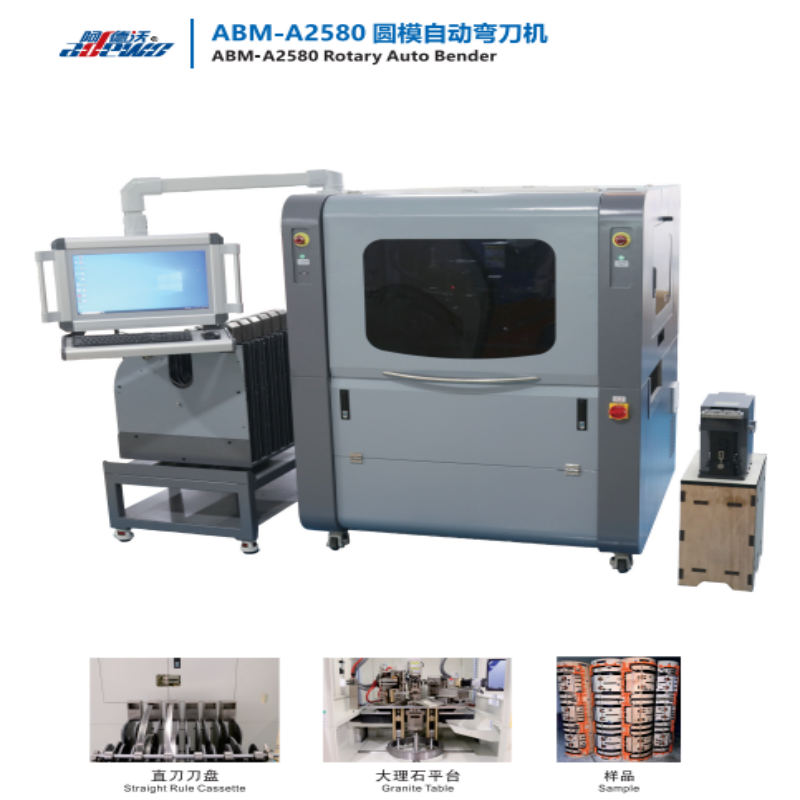
A2580 is tailored for rotary dies, supporting blade heights from 22 to 30mm,
with automatic execution of bridge punching, lipping, and other complex features.
3.Material‑specific solutions:
· Soft foam → use high‑hardness backing die to prevent compression collapse;
· Ultra‑thin films → require edge burr height ≤ 0.01 mm, achievable through our optional precision grinding process.
Once the die is set, batch‑to‑batch dimensional deviation is maintained within ±0.1 mm, with repeatability error < 0.05 mm, significantly eliminating manual cutting variability.
Suitable for both prototype runs and mass production, our solutions reduce changeover time and shorten delivery cycles.
Recommended News:
What Boxes Can You Make with the ABM-832C1 Auto Bender?
A2580 Rotary Auto Bender: Precision & Efficiency for Die Making
Copyright © 2022 Adewo Automation Equipment Co.,ltd. All rights Reserved.
Links Sitemap RSS XML Privacy Policy